AI can support scheduling, documentation, patient communication, reporting, imaging workflows, marketing, and administrative efficiency. But if dental teams enter patient information into the wrong platform, use tools without proper agreements, or rely on AI outputs without review, the practice can create serious risks around privacy, HIPAA compliance, cybersecurity, and clinical accuracy.
The best path forward is simple: start with low-risk use cases, protect patient data, review every AI vendor, train your team, and involve your Dental IT services provider before allowing AI tools into daily workflows. Darkhorse Tech helps dental practices evaluate and implement secure Dental IT solutions so new technology improves efficiency without putting patient data or operations at risk.
01Why does AI adoption matter for dental practices?
AI is quickly becoming part of modern dental operations. Practices are exploring tools for:
- Drafting patient communication
- Summarizing internal notes
- Reviewing reports
- Supporting marketing content
- Improving call handling
- Automating administrative workflows
- Enhancing imaging and diagnostic support
- Analyzing practice performance data
The opportunity is real. AI can save time, reduce repetitive work, and help teams move faster.
But dental practices are not ordinary businesses. They manage protected health information, rely on specialized software, and must maintain HIPAA compliance. That means AI adoption must be guided by cybersecurity, compliance, and strong Dental IT oversight.
The American Dental Association's AI standards for dentistry are intended to help evaluate and integrate AI systems using criteria such as safety, efficacy, transparency, and fairness. That matters because dental practices need tools that are not only useful, but also responsible and appropriate for patient care settings.
02What is the biggest AI risk for dental practices?
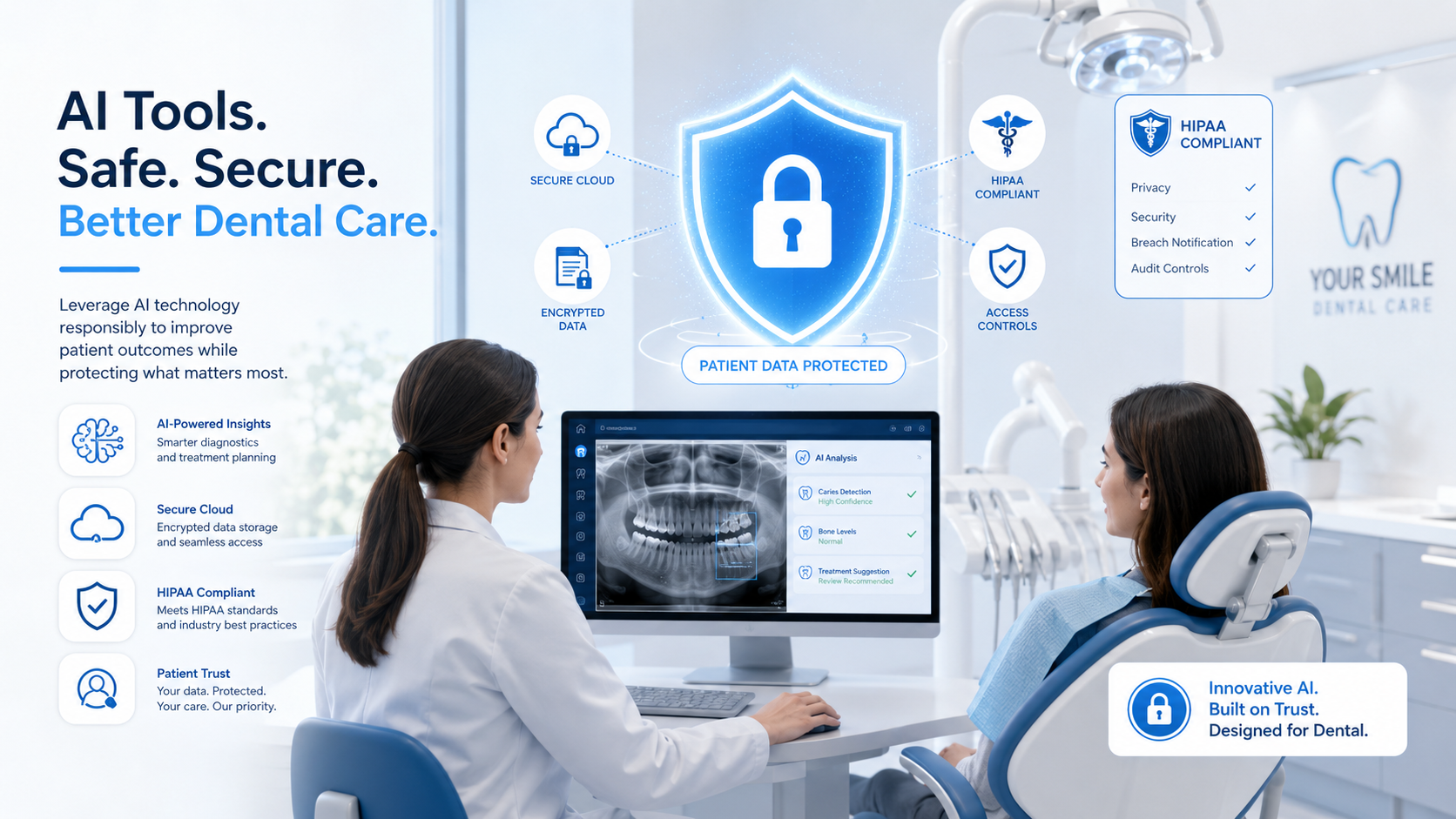
That includes information such as:
- Patient names
- Dates of birth
- Treatment notes
- Insurance details
- Radiographs
- Medical histories
- Appointment records
- Billing details
If an AI tool creates, receives, maintains, or transmits electronic protected health information on behalf of a covered entity, HIPAA considerations apply. HHS guidance on cloud services explains that covered entities may use cloud services for ePHI only when they have a HIPAA-compliant business associate agreement and otherwise comply with HIPAA rules.
In practical terms: if a dental practice wants to use AI with patient information, the tool must be reviewed for HIPAA, vendor risk, data handling, access controls, and contractual safeguards before use.
03Should AI be treated like part of your Dental IT environment?
Every AI tool used in a dental practice should be evaluated like any other system that touches operations, data, or patient communication.
That means asking:
- Does this tool access patient data?
- Does it store or train on submitted content?
- Does the vendor sign a BAA when required?
- Can user access be controlled?
- Does the tool support audit logs?
- Is data encrypted?
- Can the practice disable or remove access?
- Does the tool integrate with existing dental systems?
HIPAA's Security Rule requires covered entities and business associates to protect the confidentiality, integrity, and availability of ePHI through appropriate safeguards, and risk analysis is a required implementation specification under the administrative safeguards.
This is why dental practices should not adopt AI casually. AI belongs inside a managed Dental IT solutions strategy.
04What are safe AI use cases for dental practices?
Not every AI use case carries the same level of risk. Some are safer starting points than others.
Lower-risk AI use cases
These may be appropriate when no patient-specific information is entered:
- Drafting general marketing content
- Creating internal training outlines
- Writing generic office policy summaries
- Brainstorming blog topics
- Summarizing non-patient-facing educational content
- Creating social media captions
- Drafting general website copy
These can help the practice improve efficiency without exposing PHI.
Higher-risk AI use cases
These require much more caution:
- AI-generated clinical notes
- AI-assisted diagnosis
- Radiograph interpretation
- Patient-specific treatment communication
- Insurance documentation involving PHI
- Call summaries containing patient details
- AI tools connected to practice management software
- AI tools connected to imaging platforms
These workflows may be valuable, but they require stronger governance, vendor review, HIPAA safeguards, staff training, and clear human oversight.
05What should dental practices avoid when using AI?
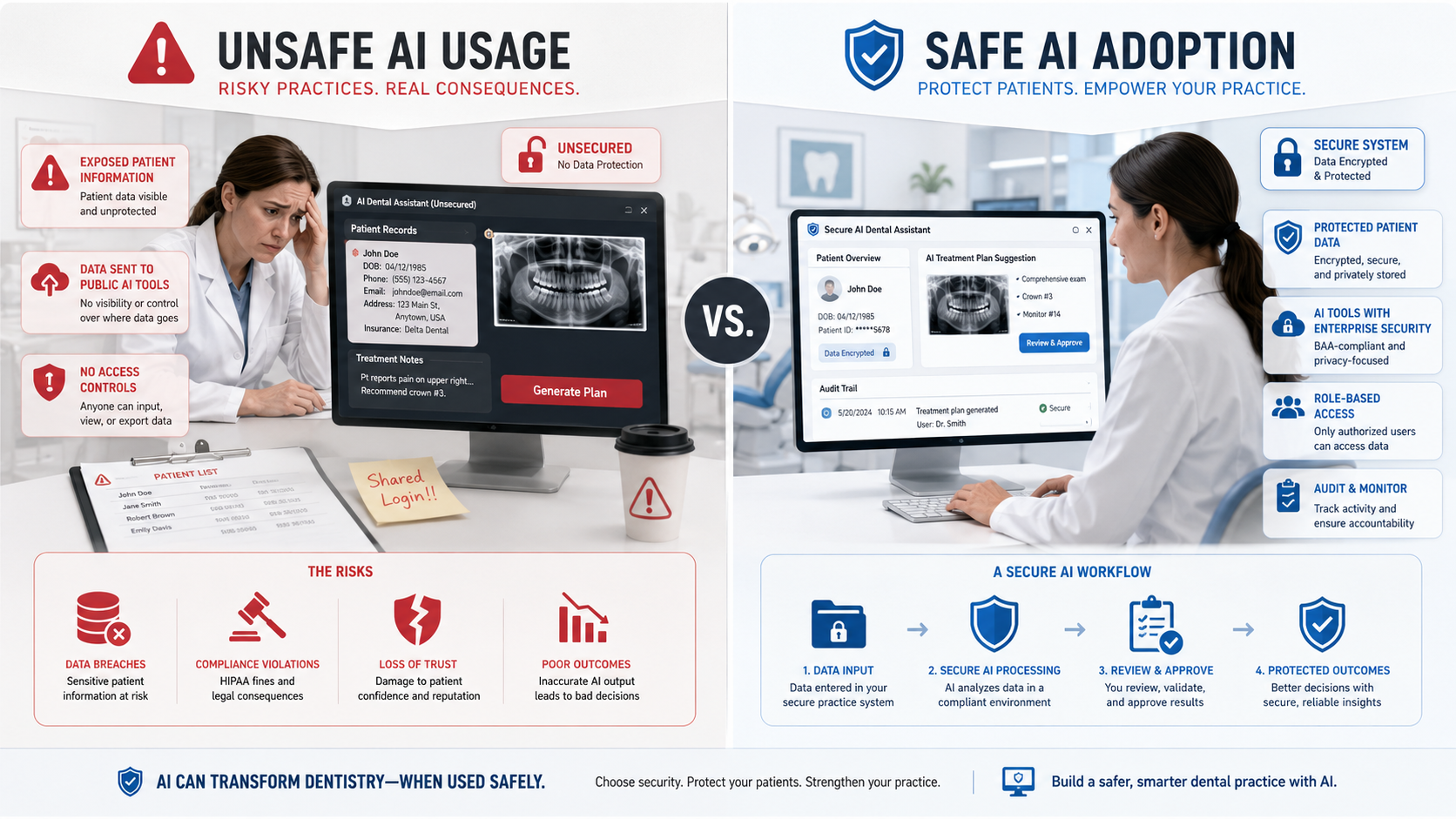
Avoid:
- Copying patient notes into public AI tools
- Uploading radiographs into unapproved AI systems
- Using free AI tools for patient communication
- Allowing staff to test AI tools without approval
- Trusting AI-generated clinical content without review
- Using AI tools without checking vendor data policies
- Assuming "secure" means "HIPAA-ready"
A tool can be useful and still be inappropriate for patient data. That is the difference between experimenting with AI and safely adopting AI.
06How should a dental practice build an AI policy?
That policy should define:
- Which AI tools are approved
- Which tools are prohibited
- Whether PHI can be entered
- Who reviews AI outputs
- Who approves new AI vendors
- How staff should report AI concerns
- Which tasks require human review
This does not need to be complicated, but it must be clear. Without a policy, staff may make their own decisions. That creates inconsistent workflows and unnecessary risk.
07How should dental practices review AI vendors?
Dental practices should review AI vendors before adoption.
A strong vendor review should include:
- HIPAA and BAA requirements
- Data storage practices
- Encryption standards
- Access controls
- Audit logging
- User permissions
- Breach notification procedures
- Integration requirements
- Data retention policies
- Whether customer data is used for model training
The NIST AI Risk Management Framework includes guidance for managing AI risks, and NIST's generative AI profile is intended to help organizations identify unique risks from generative AI and manage them in alignment with organizational goals.
For dental practices, that means AI adoption should be structured, documented, and managed, not left to individual staff experimentation.
08How do you keep humans in the loop with AI?
This is especially important for anything involving:
- Clinical documentation
- Diagnosis support
- Treatment planning
- Patient communication
- Insurance narratives
- Compliance documentation
AI can make mistakes. It can misunderstand context. It can generate confident but inaccurate outputs. A safe AI workflow requires human review before anything affects patient care, patient communication, billing, or records.
The goal is not to remove people from the process. The goal is to help the team work more efficiently while maintaining accuracy, accountability, and patient trust.
09How does AI impact dental cybersecurity?
Common risks include:
- Staff entering sensitive information into unapproved tools
- AI browser extensions collecting data
- Weak passwords on AI platforms
- No MFA on AI accounts
- AI integrations with excessive permissions
- Vendors with unclear data practices
- Lack of audit logs
- Shadow IT, where staff use tools the practice does not know about
This is why AI adoption must be connected to Dental IT services, cybersecurity, and vendor management. A dental practice should know exactly which AI tools are being used, who has access, what data is involved, and how that access is secured.
10What's a practical AI adoption checklist for dental practices?
Before adopting an AI tool, dental owners should ask:
- 1What problem does this tool solve?Do not adopt AI just because it is new. Start with a clear operational need.
- 2Will the tool touch patient data?If yes, the review process must be much stricter.
- 3Does the vendor sign a BAA when required?If PHI is involved, this is critical.
- 4Can access be controlled?Your practice should be able to manage users, permissions, and offboarding.
- 5Is MFA available?Any platform connected to practice operations should support strong account security.
- 6Are outputs reviewed by a human?AI-generated content should not be trusted blindly.
- 7Is the tool approved by your Dental IT provider?AI tools should fit into your broader Dental Information Technology environment.
- 8Is staff trained on safe use?Your team needs clear rules before using AI in real workflows.
11How does Darkhorse Tech help dental practices adopt AI safely?
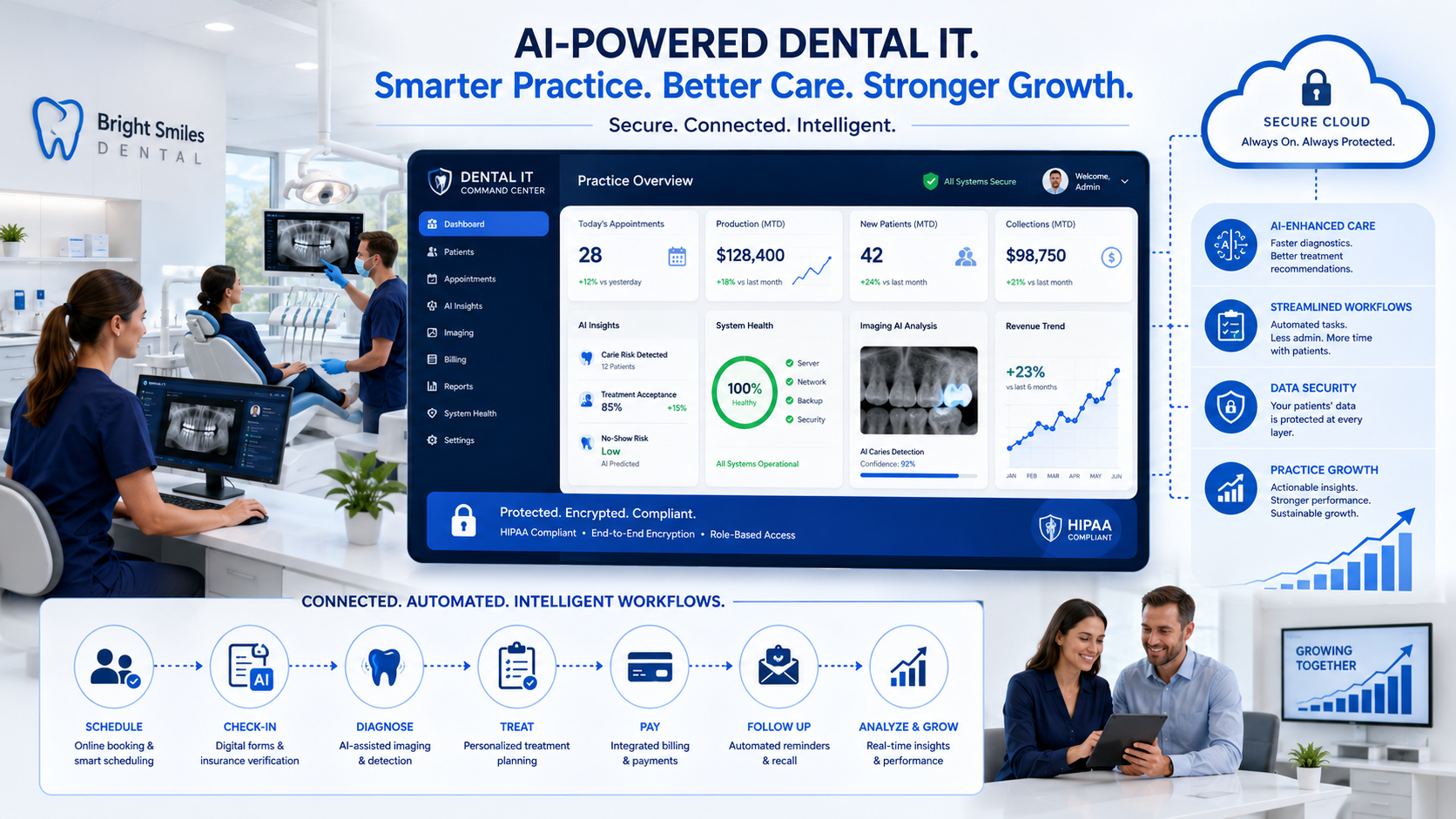
Darkhorse Tech helps dental practices evaluate new technology through the lens of security, compliance, and operational reliability. When it comes to AI, that means helping practices answer important questions before risk is introduced:
- Is this AI tool safe for dental use?
- Does it align with HIPAA requirements?
- Does it create cybersecurity risk?
- Does it integrate securely with existing systems?
- Should staff be allowed to use it?
- What policies should be in place?
- How should access be monitored?
Darkhorse Tech provides Dental IT services designed to help practices adopt technology without sacrificing security. The goal is not to stop innovation. The goal is to make sure innovation is implemented safely. The right Dental IT solutions allow practices to benefit from AI while protecting patient data, reducing risk, and keeping systems reliable.
12Why do dental practices need a proactive AI strategy?
AI is not going away. Dental practices that ignore it may fall behind. But practices that adopt it without proper controls may expose themselves to compliance, security, and operational problems. The best approach is proactive. That means:
- Start with safe use cases
- Create an AI policy
- Review vendors carefully
- Protect patient data
- Train staff
- Keep humans in control
- Involve your Dental IT provider early
This is where strong Dental Information Technology planning becomes essential. AI should support the practice, not create another unmanaged risk.
Ready to evaluate whether your practice can safely use AI?
Darkhorse Tech helps dental practices evaluate, secure, and manage new technology — including AI — as part of a complete Dental IT solutions strategy.
Final takeaway
AI can be a powerful tool for dental practices, but it must be adopted safely. The practices that benefit most from AI will not be the ones that adopt every new tool quickly — they will be the ones that build secure, compliant, well-managed workflows around the right tools. Darkhorse Tech helps dental practices make that transition with Dental IT services focused on security, compliance, and long-term technology success.
.svg)
