Choosing a dental Practice Management System (PMS) has never been just a software decision. Increasingly, it's an infrastructure, security, and scalability decision — especially as practices grow beyond a single location.
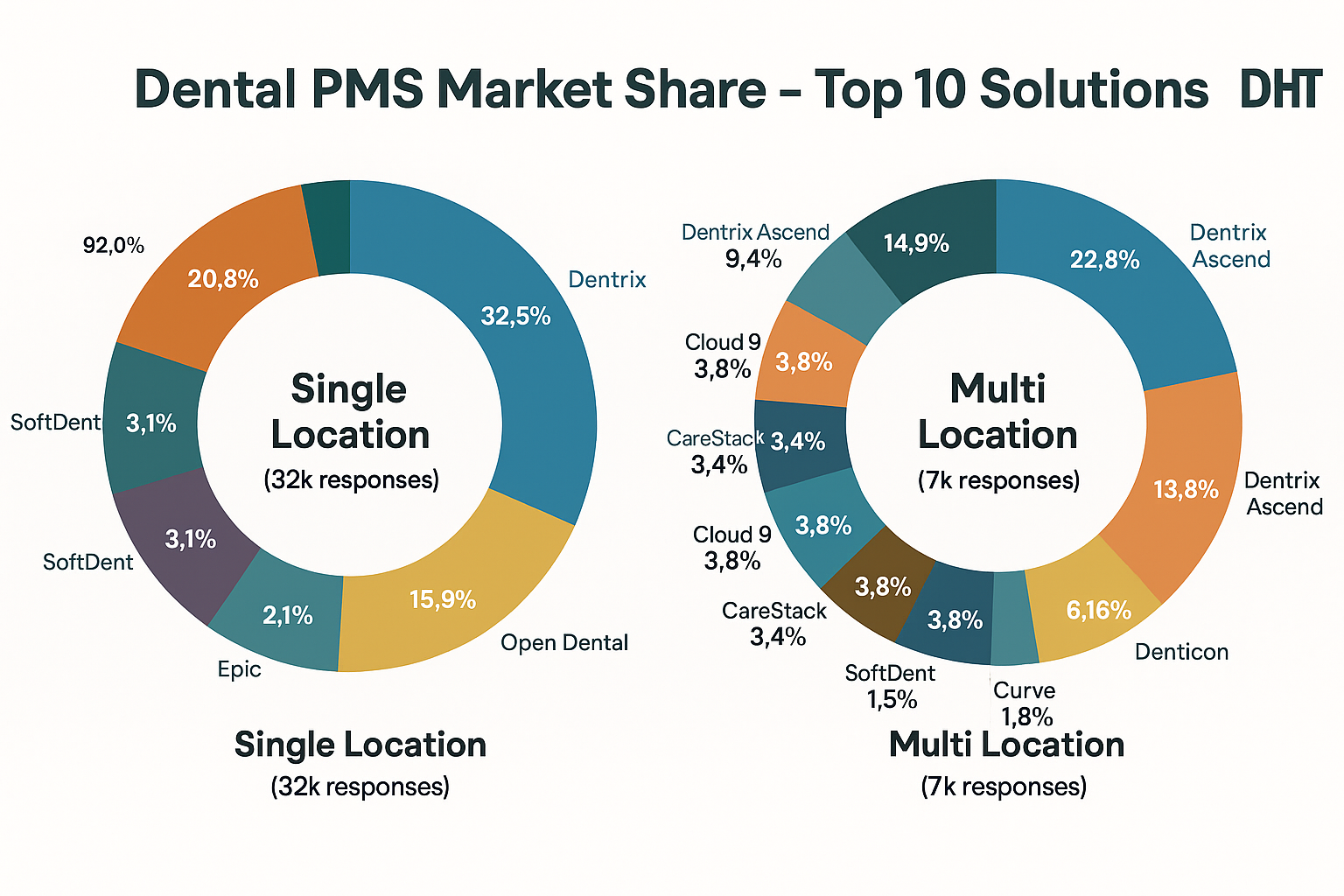
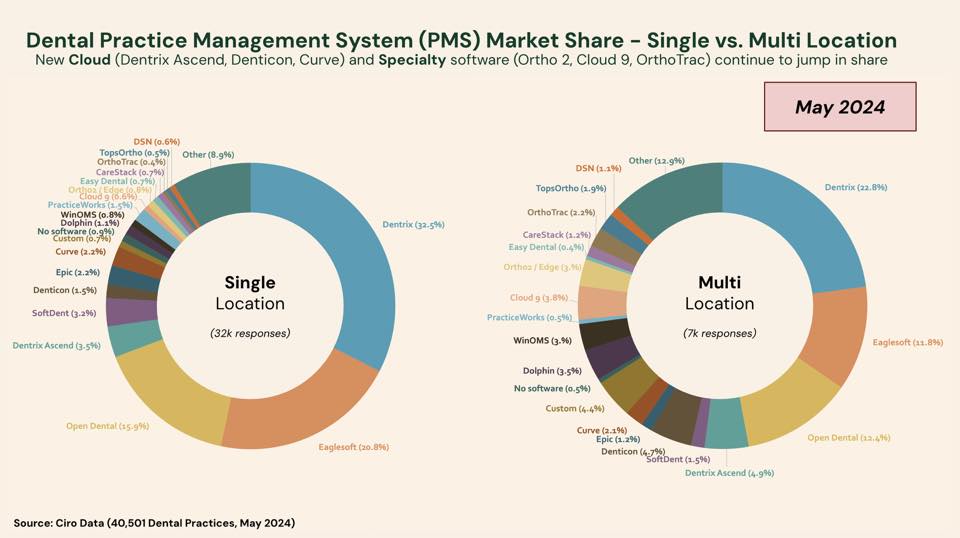
Recent data from CIRO, based on responses from 1,600+ dentists and over 40,000 dental practices, offers a clear snapshot of how PMS adoption changes as practices scale.
The Single-Location Reality: Stability Over Sophistication
Among single-location practices, PMS adoption remains heavily concentrated around legacy systems:
- Dentrix
- Eaglesoft
- Open Dental
These platforms dominate because they're familiar, proven, and — for one location — usually manageable without enterprise-level IT strategy. Many single-location practices prioritize reliability and cost control over advanced integrations or centralized management.
At this stage, most technology environments are locally hosted or lightly cloud-assisted, operationally simple, and highly dependent on a small number of workstations and users. And for many practices, that works — until it doesn't.
What Changes at Scale: Multi-Location PMS Tells a Different Story
Once practices move into multi-location territory, the PMS landscape changes noticeably. CIRO's data shows:
- Dentrix market share drops significantly
- Cloud-native and specialty platforms gain ground
- Custom and hybrid solutions become more common
In other words, scale introduces diversity — and diversity introduces complexity. Multi-location practices are far more likely to adopt cloud-based PMS platforms, specialty software (OMS, Ortho, multi-discipline workflows), and custom configurations to support growth, reporting, and integrations.
The Hidden Cost of PMS Growth: Infrastructure & Security
What often gets overlooked in PMS discussions is what happens around the software. As PMS environments evolve, practices must contend with:
- Centralized user access across locations
- HIPAA compliance across distributed systems
- Increased ransomware exposure
- Higher uptime expectations
- Integration with imaging, billing, analytics, and third-party tools
A PMS that works fine in one office can quickly strain under multiple locations, remote access needs, shared databases, and cloud-hosted workflows. This is where many growing practices feel friction — not because the PMS is "bad," but because the supporting IT environment wasn't designed to scale.
The Darkhorse Tech Perspective
At Darkhorse Tech, we see this pattern daily across hundreds of dental practices nationwide.
Multi-location practices don't fail because they chose the "wrong" software. They struggle when infrastructure isn't standardized, security controls don't scale, cloud and on-prem systems aren't architected together, and IT strategy lags behind operational growth.
The most successful DSOs and growing practices treat PMS selection and IT architecture as one strategic decision, not two separate ones.
What Growing Practices Should Ask Before Scaling
Before adding locations — or changing PMS platforms — practices should be asking:
- Can our IT environment support centralized access securely?
- Are we designed for uptime across all locations?
- How do we manage user permissions at scale?
- Is our data protected consistently, everywhere?
- Can our systems grow without constant rework?
These questions matter far more than brand names on a PMS list.
Final Thought
The CIRO data confirms what the industry is already experiencing: growth drives complexity, and complexity demands intention. Whether you're on Dentrix, Open Dental, Dentrix Ascend, or a cloud-native PMS, success at scale comes down to how well your technology ecosystem is designed to support it. That's where the real work begins.
Sources: CIRO Dental PMS Market Share Data (40,501 Dental Practices, May 2024); CIRO Blog: What Practice Management Software Do 1,600+ Dentists Use?
Darkhorse Tech is here for you.
Your dental technology should support your practice, not slow it down. Darkhorse Tech helps dental offices stay secure, connected, and productive with IT support built specifically for dentistry.
The bottom line
PMS choice doesn't create complexity on its own — growth does, and the PMS simply exposes it. Single-location practices can usually get by on legacy platforms like Dentrix, Eaglesoft, or Open Dental without enterprise IT strategy.
Multi-location practices need PMS selection and IT architecture treated as one strategic decision, not two, or the supporting infrastructure will strain under centralized access, compliance, and uptime demands the software alone can't solve.
.svg)
