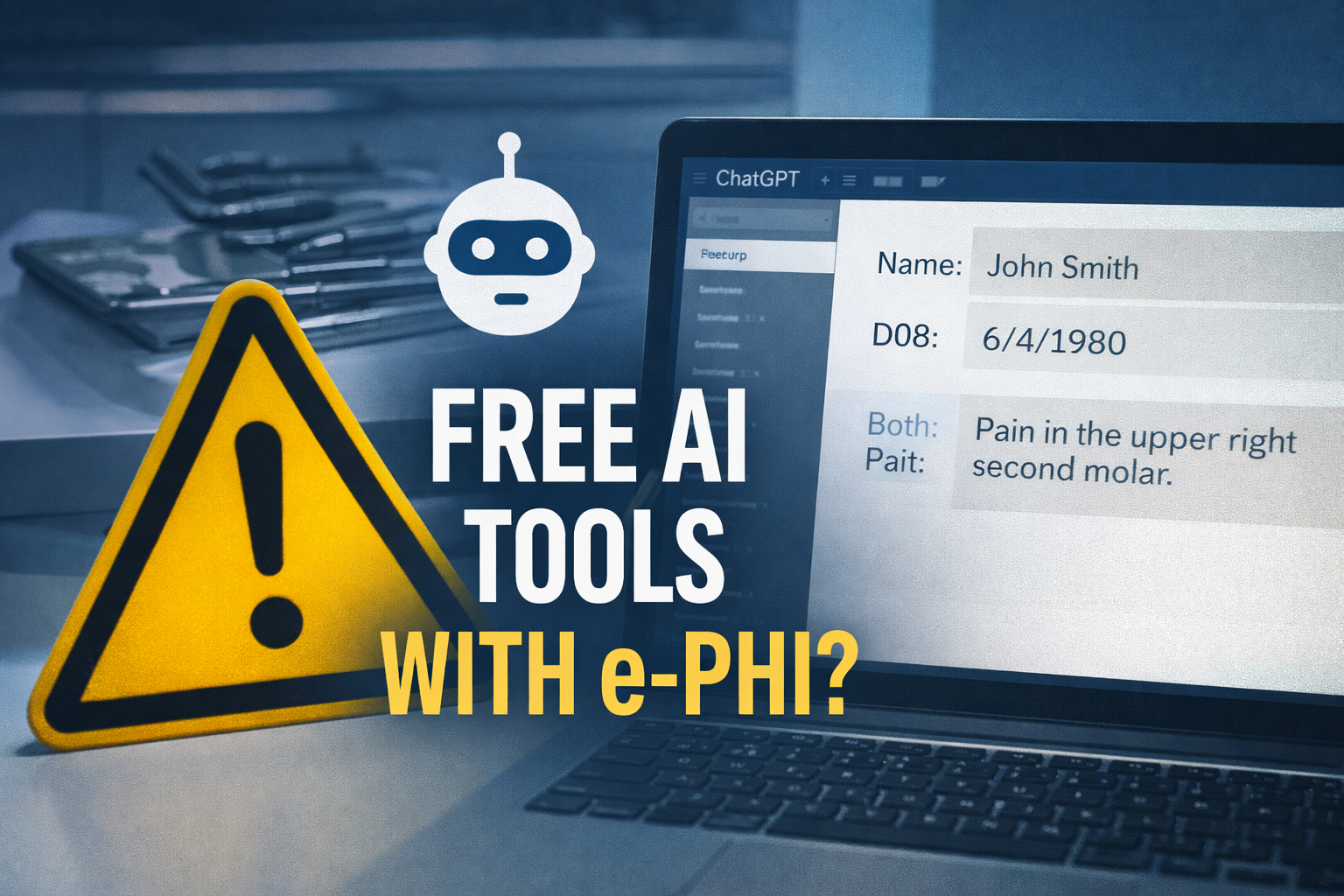
AI tools like ChatGPT, Gemini, Grok, Grammarly, and free note-taking or transcription apps are everywhere — and they're incredibly useful. But there's a growing problem most dental practices don't realize they have.
How This Is Actually Happening in Dental Offices
Most of the time, this isn't malicious. It's convenience. Here are real-world examples we're seeing:
- A team member pastes patient notes into ChatGPT to \u201cclean them up\u201d
- An office manager uses an AI tool to summarize emails with patient info
- Someone uploads a document with names, DOBs, or insurance data to an AI assistant
- A dentist uses a free transcription AI to turn voice notes into chart entries
- Staff uses Grammarly or browser AI extensions on emails containing PHI
The intention is productivity. The result can be unauthorized disclosure of e-PHI.
Why Free AI Tools Are a HIPAA Problem
Most free AI tools:
- Do not sign Business Associate Agreements (BAAs)
- May store or retain submitted data
- May use inputs to train their models
- Do not guarantee data residency or deletion
\u201cBut It Wasn\u2019t a Hack\u2026\u201d \u2014 Why That Doesn\u2019t Matter
This is the part many practices miss. HIPAA violations don't require a ransomware attack, a malicious hacker, or a breach headline. Improper disclosure alone is enough.
Using an unapproved AI tool with e-PHI can trigger:
- Compliance violations
- Reportable incidents
- Regulatory scrutiny
- Loss of patient trust
And yes — it can still happen even if no data was "stolen."
Why This Risk Is Growing in 2025+
AI adoption is exploding faster than policies can keep up:
- Built-in AI is now embedded in browsers, email clients, and operating systems
- Staff may not even realize when AI is \u201con\u201d
- Younger employees assume AI tools are safe by default
- There is very little training around AI + HIPAA in most practices
What Dental Practices Should Do Right Now
You don't need to ban AI — but you do need guardrails.
01Create an AI Usage Policy
Staff should clearly know what AI tools are approved, what data is never allowed to be entered, and that PHI and AI don't mix unless explicitly approved.
02Disable or Restrict AI Where Appropriate
This may include browser AI features, free AI extensions, built-in OS assistants, and unapproved transcription tools.
03Train Your Team
Most violations happen because people don't know better. A short, clear training can eliminate a massive amount of risk.
04Use HIPAA-Safe Alternatives
There are AI-enabled tools designed for healthcare — but they must be properly vetted, covered by BAAs, and configured correctly.
05Monitor for Data Leakage
At Darkhorse Tech, we monitor endpoint behavior and application usage to identify risky tools before they become incidents.
How Darkhorse Tech Helps
We help dental practices and DSOs:
- Identify AI tools currently in use (even ones leadership doesn't know about)
- Lock down risky apps and browser extensions
- Create AI + HIPAA policies that actually work
- Train staff in real-world, non-technical language
- Implement secure, compliant alternatives where appropriate
Darkhorse Tech is here for you.
Your dental technology should support your practice, not slow it down. Darkhorse Tech helps dental offices stay secure, connected, and productive with IT support built specifically for dentistry.
The bottom line
AI can be powerful — but only when used responsibly. Most HIPAA-and-AI violations aren't malicious, they're staff trying to save time without realizing where patient data is actually going.
A clear AI usage policy, restricted access where needed, and short staff training can close most of that gap before it becomes an incident.
.svg)
